
Managing White Mold in Soybeans
Scientists call white mold in soyabeans as Sclerotinia sclerotiorum, and it is a huge problem for soybean farmers all over the world.

For white mold in soybeans treatment, HarzShield is the best fungicide for white mold. It is paired with Trichoderma Harzianum, which can help reduce the fungal growth and increase plant immunity. This fosters healthier plants and improves soil health without resistance issues.

Fungus disease reduces yield and impacts soybean quality, necessitating awareness among farmers and agricultural workers about white mold signs. Effective management techniques are crucial. This blog aims to explain white mold on soybeans, its signs, and best practices for combating the widespread disease.
How to Understand White Mold in Soybeans
Because white mold grows best in cool, damp places, soybean fields with thick canopies and lots of humidity are great places for it to grow. As sclerotia, the fungus starts its life cycle. These can stay in the soil for years, waiting for the right conditions to attack plants. When the conditions are right, which usually happens when soybeans are blooming, the sclerotia germinate and grow into mushroom-like structures that release spores. These germs get into the soybean plants and cause the disease to grow.
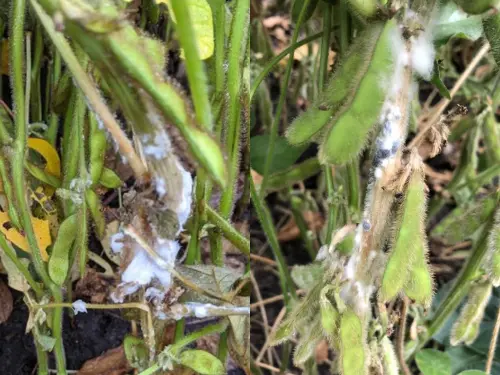
Signs of White Mold
- Plants That Wilt: To begin with, soybean plants that have white mold may start to wilt, starting with the top leaves. People often mistake this drooping for water stress because it looks like the plants aren’t getting enough water. But if you look more closely, you might see that the wilting continues even when the plant is properly watered, which could mean it has an infection.
- There is white, cottony mycelial growth: Seeing a white, cottony material on the stems and sometimes the branches of soybean plants is a clear sign of white mold. This stuff is the mycelial growth of the fungus Sclerotinia sclerotiorum. It’s most often seen at or near the surface of the dirt, which is a good place for fungi to grow. This mycelium can take over big parts of the stem, which causes more symptoms and the plant to die.

- Formation of Sclerotia: As the disease gets worse, sclerotia, which are hard, black structures, start to form inside the white, cottony mycelium. These sclerotia are the fungus’s main way of staying alive, letting it stay alive in bad circumstances. They are either on the outside of roots or deep inside the tissue. Sclerotia are a key sign of white mold. They can stay in the soil for years, which means that future crops could be at risk.
- Lower Yield and Quality: White mold has effects on the plant that can be seen, but it also lowers the yield and quality of the soybeans in a big way. Plants that are infected might make fewer pods, and the seeds inside might not be as good. The disease can also make harvesting harder because plants that are sick are less likely to grow well.
How do you control white mold in soybeans?
Here are easy ways for white mold soybeans treatment:
- Crop Rotation: Avoid planting soybeans in the same field successively to reduce soil-borne inoculum levels of the pathogen.
- Tillage Practices: Implementing no-till or reduced tillage can reduce the survival of the sclerotia in soil, thus lowering disease pressure.
- Planting Resistant Varieties: Select soybean varieties that have shown resistance or tolerance to white mold.
- Row Spacing and Planting Density: Wider row spacing and reduced planting densities can improve air circulation and reduce humidity within the crop canopy, making conditions less favorable for disease development.
- Irrigation Management: Avoid overhead irrigation during flowering to minimize moisture on plant surfaces, which can promote disease development.
- Field Hygiene: Removing or burying infected plant residues can reduce the source of inoculum for future crops.
- Biological Control with HarzShield and Trichoderma Harzianum: The fungicide for mold such as HarzShield, leveraging the active ingredient Trichoderma Harzianum, is beneficial in managing white mold on soybeans through its biological action. Trichoderma Harzianum inhibits pathogenic fungi growth, breaks down their cell walls, and stimulates plant immune systems. It controls disease spread and promotes healthier plant growth and soil conditions. This makes it a sustainable and eco-friendly option for soybean disease management.
Other Problems and Solutions for soybean, tomoto and cucumber :
- Treat soybean cyst nematode
- Controlling Root Knot Nematode on Tomato and Cucumber
- Managing Septoria Leaf Spot Tomato
References:
- Sumida, Ciro H., et al. “Trichoderma asperelloides antagonism to nine Sclerotinia sclerotiorum strains and biological control of white mold disease in soybean plants.” Biocontrol science and technology 28.2 (2018): 142-156.
- Juliatti, Fernando C., et al. “Trichoderma as a biocontrol agent against Sclerotinia stem rot or white mold on soybeans in Brazil: usage and technology.” Trichoderma-The Most Widely Used Fungicide 39 (2019).
Previous Page:
Previous Page:
Bashirat Alhassan
Time
2026-06-20 23:03
IP
102.90.97.250
Message content:
Good afternoon, please I would love to make enquiry on your technical beauveria bassiana germination grade and price.
FIKILE MATHUNJWA
Time
2026-05-04 21:51
IP
102.212.203.29
Message content:
Please this is an SOS. I have just started growing coffee arabica and this is my first harvest. However as the cherries started to rippen the skin changed to black and dried up. how can I can I get assistance please? Im from Eswatini
John Jethro
Time
2026-04-29 08:24
IP
112.202.112.53
Message content:
I dealt with root rot on one of my orchids and it escalated fast, just like described. I tried disinfecting tools and doing a quick rinse treatment, but I learned Physan is more for sanitation than a full cure. Midway I checked https://purelyponds.com/product/physan-20-1-gallon/ and adjusted my dilution. Cutting damaged roots and improving airflow helped way more.
gautam
Time
2026-01-17 14:04
IP
223.178.84.231
Message content:
Good details. As far as pest management and control is concerned there are quite a few pesticides which effects only the pests and does not harm the ecosystem. Safer for humans and plants.
raghav
Time
2025-12-23 19:09
IP
223.178.86.132
Message content:
Insects and plants are like made for each other. Plants and flowers do attract insects. But if you are worried about caterpillars which eat up the plants and their leaves then it is best to go for a pesticide or contact a pest control company.
Ganesh Kumar C
Time
2025-10-21 13:44
IP
223.178.86.3
Message content:
It is always best to do a professional pest control service. A complete pest control work for insects will be good. Termites and bedbugs requires pesticides which are specifically made for them. For all other insects a common pesticide will do. Many insects are ****erous and can cause serious health issues so better to get the pest control work done.
diya
Time
2025-09-01 19:30
IP
223.178.82.254
Message content:
There might be hundreds of home made methods to prevent mosquitoes but all are not that effective. Mosquitoes are ****erous so better not to take risk. Fixing mosquito nets is the best and the only solution.
Bobby soni
Time
2025-06-14 17:28
IP
2409:4056:2011:153c:f087:5952:16f1:6d88
Message content:
शिमला मिर्च का पौधा मुरझाने के लिए क्या करें
Glenys Smith
Time
2025-05-13 10:22
IP
24.142.9.36
Message content:
Can I order Tranum Shield on line from you.
Aniefiok Jackson
Time
2025-01-07 19:32
IP
197.210.79.219
Message content:
What type of drug will I use for pepper when it wilter
回复内容:
这里是占位文字
Powered By
这里是占位文字
2025-02-13 09:12
Ovais Mirza
Time
2024-12-30 20:28
IP
139.5.254.149
Message content:
This article provides insightful and practical tips for tackling Fusarium wilt in tomatoes using organic methods. It emphasizes the importance of hygiene, disease-resistant varieties, and crop rotation to prevent and manage the disease. The advice on maintaining well-draining soil and proper watering techniques is crucial for reducing the likelihood of Fusarium wilt. A helpful guide for organic gardening!
回复内容:
这里是占位文字
Powered By
这里是占位文字
2025-02-12 17:40
该组件调取留言后的信息,使用后若不显示,则需要检查下后台有没有留言者的留言数据。有的话还不显示,需要重新绑定【在线留言】应用
Aniefiok Jackson
Ovais Mirza
Latest Post

Cucumber Leaf Blight: How to Identify, Prevent, and Manage Common Leaf Diseases
Once the brown spots, yellow patches and dead leaf area appears throughout the crop, cucumber leaf blight can be a serious issue for farmers. The symptoms may decrease the production of good fruit and can have an impact on fruit quality and quantity as well.
Mycorrhizal Fungi and Plants: Benefits, Risks, and What Gardeners Should Know
While plants need the soil to provide them with nutrients, they aren't able to utilize nutrients in all soil. This is where arbuscular mycorrhizal fungi (AMF) may be of great benefit. These small soil bugs bring the plants closer to the soil, increasing the plants ability to absorb nutrients, such as phosphorus uptake by mycorrhizal fungi.
Verticillium Wilt Olive Tree: Symptoms, Causes, and Effective Management Strategies
Verticillium wilt is a disease that cannot be managed with a single treatment, but needs to be managed with an integrated approach. The risk can be mitigated by using healthy planting material, growing particularly disease resistant cultivars (if available) and avoiding the transfer of contaminated soil onto the farm and by good orchard hygiene.
CONTACT US
Office 38/1502, No 660,Hanguang Rt., Changsha City, Hunan, China


